GRADEBOOK TOOLS BLOG
How is weighted GPA calculated?
Short answer: Weighted GPA = (sum of grade points × credit hours) ÷ (sum of credit hours). Biology A (4 cr), History B+ (3 cr), and Algebra B (3 cr) yield 34.9 quality points ÷ 10 credits = 3.49.
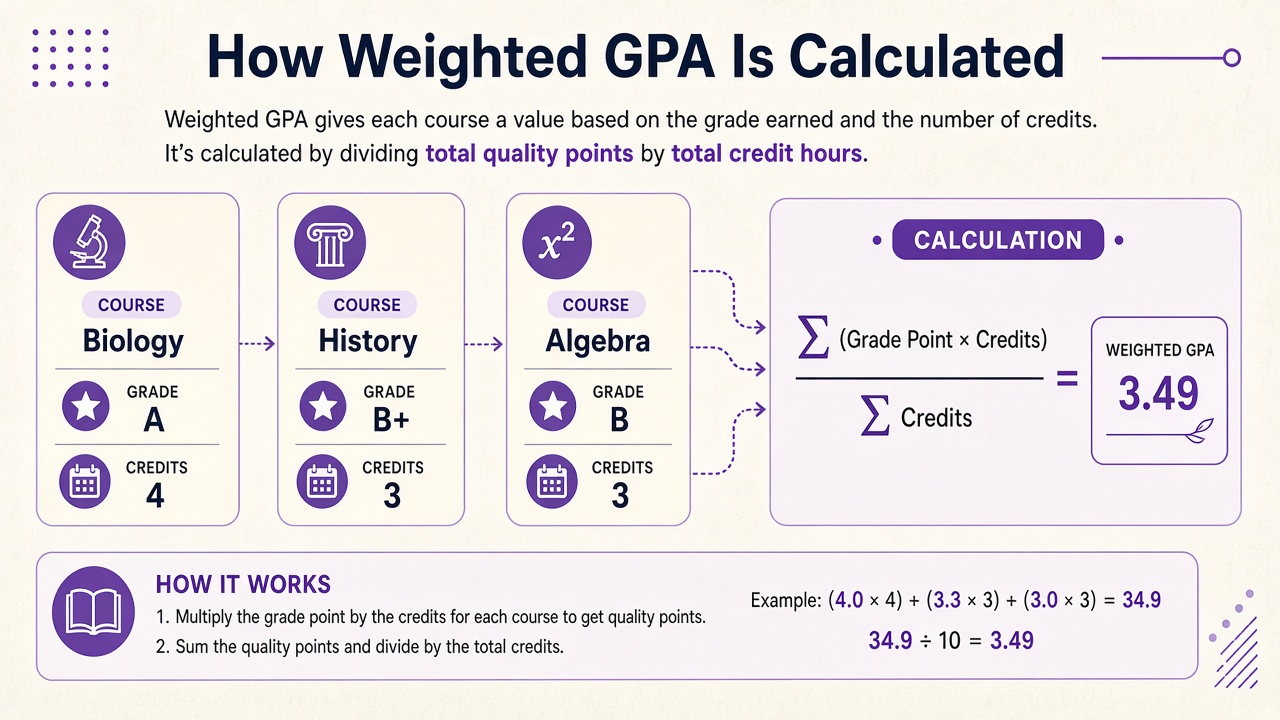
What “weighted” means here
In GPA talk, weighted by credits means a 4-credit course counts more than a 1-credit lab. That is different from a high-school “weighted GPA” that adds Honors or AP bumps—those are extra grade-point boosts on top of the credit weighting.
Most college term GPAs use a 4.0 letter map such as:
- A = 4.0 · A− = 3.7 · B+ = 3.3 · B = 3.0 · B− = 2.7
- C+ = 2.3 · C = 2.0 · C− = 1.7 · D+ = 1.3 · D = 1.0 · D− = 0.7 · F = 0.0
Your registrar may differ slightly on plus/minus values—always prefer the official scale.
Step-by-step with numbers
- Convert each letter to grade points.
- Multiply by that course’s credits to get quality points.
- Add quality points; add credits.
- Divide: GPA = total quality points ÷ total credits.
History: 3.3 × 3 = 9.9
Algebra: 3.0 × 3 = 9.0
Total: 34.9 quality points ÷ 10 credits = 3.49 GPA
Unweighted vs credit-weighted
If every course has the same credits, a simple average of the grade points matches the credit-weighted result. If credits differ, the simple average is wrong. Averaging 4.0, 3.3, and 3.0 as (4.0+3.3+3.0)/3 = 3.43 understates the 4-credit A; the credit-weighted value is 3.49.
College term vs cumulative
A term GPA uses only that term’s courses. A cumulative GPA folds prior quality points and credits together:
Example: prior 3.20 over 30 credits, then a term with 34.9 quality points over 10 credits → (3.20×30 + 34.9) ÷ 40 = 130.9 ÷ 40 = 3.2725.
High school weighted bumps
Many high schools keep an unweighted 4.0 GPA and a separate weighted GPA where Honors adds +0.5 and AP/IB adds +1.0 (often capped at 5.0). That “weight” is not the same as college credit hours—read the district policy before comparing numbers across schools.
Try the calculators
Use the GPA calculator for a quick credit-weighted 4.0 average, the college GPA calculator for term + cumulative, or the high school GPA calculator when Honors/AP bumps apply.
Percent grades on a 4.0 map
Some transcripts store percentages. A common conversion before weighting is: 93–100 → 4.0, 90–92 → 3.7, 87–89 → 3.3, and so on. Always use your school’s published table. Mixing a percent average with letter grade points in the same term without converting first will not match the registrar.
Why two students with “the same grades” differ
Both earn A, B+, B. Student A takes the A in a 4-credit lab lecture; Student B takes the A in a 1-credit seminar. Credit-weighted GPA rewards the heavier course. Scholarship cutoffs and major GPAs almost always use the credit-weighted figure, not a course-count average.
Pass/fail, withdrawals, and repeated courses
Pass/fail courses usually contribute credits toward graduation but zero quality points and are omitted from the GPA divisor—confirm local rules. Withdrawals may appear on the transcript without entering the GPA. Repeated courses sometimes replace the earlier attempt in the cumulative calculation; sometimes both attempts remain. Because policies diverge, treat any third-party GPA tool as an estimate until it matches your degree audit.
Quick verification checklist
- List each graded course with official credits.
- Convert letters with the school’s plus/minus table.
- Compute quality points and divide by graded credits only.
- Compare against the student portal’s term GPA to one or two hundredths.
If you are off by a large margin, you likely included a non-GPA course or used the wrong plus/minus values. If you are off by 0.01–0.02, rounding order (per course vs final division) is the usual cause.
Sample term you can recompute by hand
Chemistry A− (4 cr), Writing B+ (3 cr), Statistics A (3 cr), Seminar A (1 cr):
Credits = 11 → GPA = 40.7 ÷ 11 = 3.70
Drop the 1-credit seminar and the GPA becomes 36.7 ÷ 10 = 3.67. Small-credit courses move the average less—another reason credit weighting matters for planning.