GRADEBOOK TOOLS BLOG
What grade do I need on my final?
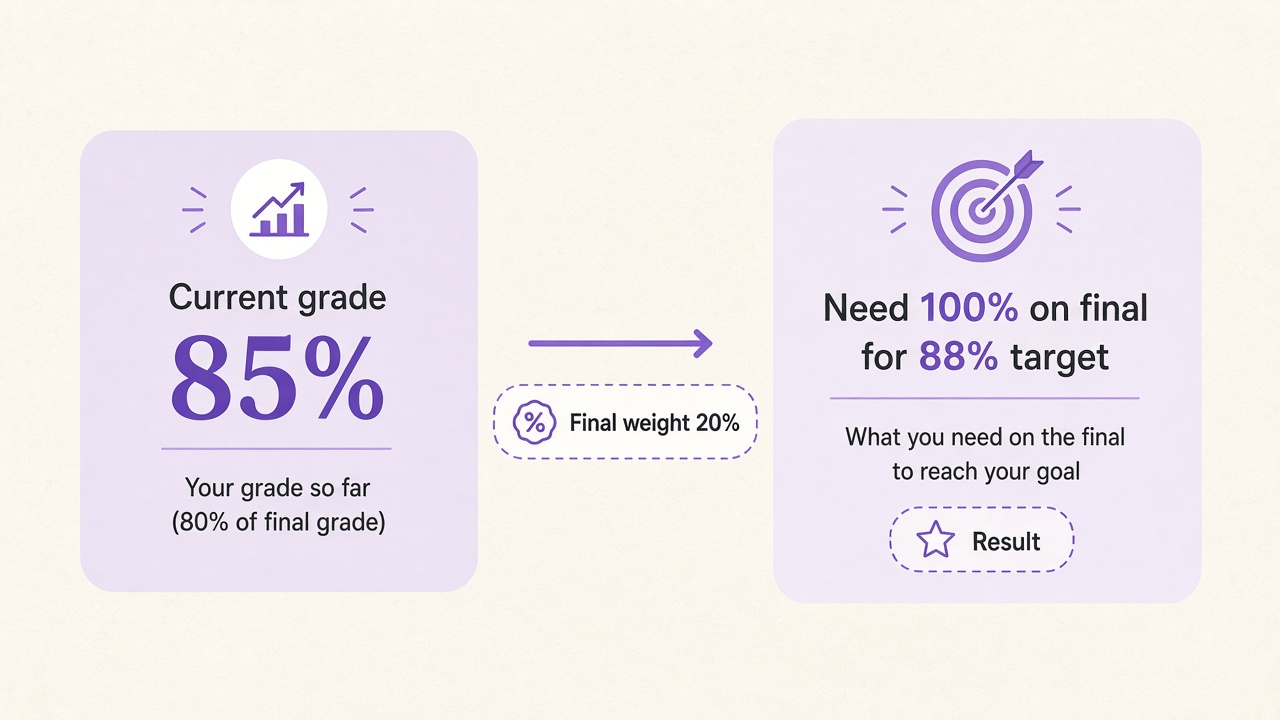
Short answer: Required final = (target − current × (1 − final weight)) ÷ final weight. With an 85% current average, a final worth 20%, and an 88% target, you need exactly 100% on the exam.
What the question really asks
“What grade do I need on my final?” means: given everything already graded, what percentage must you earn on the remaining final exam so the overall course hits a chosen target. It is not asking for another course average—it is asking for the exam score itself.
Three numbers matter, and they must match your syllabus:
- Current grade — the average of all non-final coursework. Exclude the final and any placeholder zero for it.
- Final exam weight — the percentage of the course the final is worth (for example 20% or 40%).
- Target grade — the overall course percentage you want (for example 90% for an A threshold at your school).
The formula
where w is the final weight as a decimal (20% → 0.20).
Rearranged, the same idea is: the points you still need from the final, divided by how much the final counts.
Worked example (85%, 20% final, 88% target)
- Non-final share of the course: 1 − 0.20 = 0.80.
- Points already locked in: 85 × 0.80 = 68.
- Points still needed for an 88% course: 88 − 68 = 20.
- Required exam score: 20 ÷ 0.20 = 100%.
Check forward: 85 × 0.80 + 100 × 0.20 = 68 + 20 = 88. The target is reachable with a perfect final—but not with anything less.
When the answer is above 100%
Same current grade and weight, but a 90% target:
A normal final capped at 100% can produce at most 85 × 0.80 + 100 × 0.20 = 88% overall. The calculator is not broken—the target is out of reach without extra credit, a curve, or unfinished work that can still raise the current average.
When the answer is zero or negative
Current 95%, final 20%, target 70%:
You have already secured that particular target under these weights. Schools may still require you to take the exam or meet a minimum score—check the syllabus.
Common mistakes
- Entering a single recent test as “current grade” instead of the full non-final average.
- Leaving a LMS zero for the final inside the current average.
- Ignoring other unfinished assignments; this model assumes one remaining final.
- Assuming every school uses 90% for an A—use your own cutoff.
Try it with your numbers
Open the free final grade calculator, enter current grade, final weight, and target, then compare five possible exam outcomes. Pair it with the semester grade calculator if your term still has multiple pieces left.
Another worked case: 84% current, 40% final, 90% target
Non-final share: 0.60. Locked points: 84 × 0.60 = 50.4. Still needed: 90 − 50.4 = 39.6. Required final: 39.6 ÷ 0.40 = 99%.
Forward check: 84 × 0.60 + 99 × 0.40 = 50.4 + 39.6 = 90. If the exam is scored in whole points out of 50, 99% means about 49.5 points—so plan for 50/50 unless half-points are allowed.
How this differs from a weighted gradebook
The home gradebook calculator builds an overall from many assignments and categories. The final-grade question collapses everything unfinished into one remaining exam. If you still have a project and a final left, either fold the project into an updated current average first, or use a multi-piece planner such as the semester grade calculator.
Reading the five outcome scenarios
Once you know the minimum required final, compare realistic exam scores. With 85% current and a 20% final:
- 60% on the final → 85×0.8 + 60×0.2 = 80% course
- 70% → 82%
- 80% → 84%
- 90% → 86%
- 100% → 88%
Those scenarios answer a different question—“what happens if I score X?”—while the main formula answers “what do I need for target T?” Use both: pick a reachable T from the scenario table, then confirm the required exam score.
Rounding and point increments
Minimum required scores on Gradebook Tools are rounded up to the next 0.01 percentage point so a truncated display cannot leave you short. If the exact need is 88.333…%, plan on at least 88.34%. Convert to exam points only after you know the exam’s total and whether half-points exist.